Atlas of Ancient History › People › The Hellenistic world
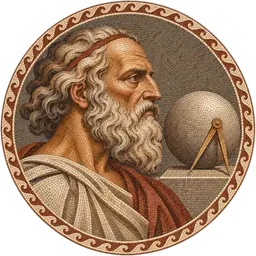
Archimedes
Archimedes wrote his works as letters to other mathematicians, among them Eratosthenes, to whom he sent his Method of mechanical theorems.1 Plutarch calls him a kinsman and friend of King Hiero, and says that to show that any weight could be moved by a given force he drew a loaded merchant ship to him with compound pulleys.2 When Marcellus besieged Syracuse, Archimedes' engines, paid for by Hiero, wrecked the Roman ships and sambucae, and Marcellus joked that Archimedes was ladling sea-water with his ships.3 Plutarch says he asked for a cylinder enclosing a sphere to be set on his tomb, with the ratio of the two solids.4 When the city fell he was killed by a soldier who did not know who he was, while he was absorbed in figures he had drawn in the dust, Livy says; Plutarch tells two versions of the soldier's anger.5
Events
Ties
- Marcellus grieved for Archimedes Livy 25.31
- Hieron II kinsman and friend of Archimedes Plutarch, Marcellus 14.7
- built engines paid for by Hieron II Polybius 8.7.2
- wrote the Method for Eratosthenes Archimedes, Method pr1.2
What the sources say
“And yet even Archimedes, who was a kinsman and friend of King Hiero, wrote to him that with any given force it was possible to move any given weight; and emboldened, as we are told, by the strength of his demonstration, he declared that, if there were another world, and he could go to it, he could move this”
καὶ μέντοι καὶ Ἀρχιμήδης, Ἱέρωνι τῷ βασιλεῖ συγγενὴς ὢν καὶ φίλος, ἔγραψεν ὡς τῇ δοθείσῃ δυνάμει τὸ δοθὲν βάρος κινῆσαι δυνατόν ἐστι· καὶ νεανιευσάμενος, ὥς φασι, ῥώμῃ τῆς ἀποδείξεως εἶπεν ὡς, εἰ γῆν εἶχεν ἑτέραν, ἐκίνησεν ἂν ταύτην μεταβὰς εἰς ἐκείνην
Plutarch, Marcellus 14.7 · tr. Bernadotte Perrin
“Though reduced almost to despair by these baffling inventions of Archimedes, and though he saw that all his attempts were repulsed by the garrison with mockery on their part and loss to himself, Marcellus could not yet refrain from making a joke at his own expense, saying that Archimedes was using his ships to ladle out the sea-water, but that his harps not having been invited to the party were buffeted and turned out with disgrace”
Μάρκος δὲ δυσχρηστούμενος ἐπὶ τοῖς ἀπαντωμένοις ὑπʼ Ἀρχιμήδους, καὶ θεωρῶν μετὰ βλάβης καὶ χλευασμοῦ τοὺς ἔνδον ἀποτριβομένους αὑτοῦ τὰς ἐπιβολάς, δυσχερῶς μὲν ἔφερε τὸ συμβαῖνον, ὅμως δʼ ἐπισκώπτων τὰς αὑτοῦ πράξεις ἔφη ταῖς μὲν ναυσὶν αὐτοῦ κυαθίζειν ἐκ θαλάττης Ἀρχιμήδη, τὰς δὲ σαμβύκας ῥαπιζομένας ὥσπερ ἐκσπόνδους
Polybius 8.6 · tr. Evelyn S. Shuckburgh
“So true it is that one man and one intellect, properly qualified for the particular undertaking, is a host in itself and of extraordinary efficacy. In this instance, at any rate, we find the Romans confident that their forces by land and sea would enable them to become masters of the town, if only one old man could be got rid of; while as long as he remained there, they did not venture even to think of making the attempt, at least by any method which made it possible for Archimedes to oppose them”
οὕτως εἷς ἀνὴρ καὶ μία ψυχὴ δεόντως ἡρμοσμένη πρὸς ἔνια τῶν πραγμάτων μέγα τι χρῆμα φαίνεται γίνεσθαι καὶ θαυμάσιον. ἐκεῖνοι γοῦν τηλικαύτας δυνάμεις ἔχοντες καὶ κατὰ γῆν καὶ κατὰ θάλατταν, εἰ μὲν ἀφέλοι τις πρεσβύτην ἕνα Συρακοσίων, παραχρῆμα τῆς πόλεως κυριεύσειν ἤλπιζον, τούτου δὲ συμπαρόντος οὐκ ἐθάρρουν οὐδʼ ἐπιβαλέσθαι κατά γε τοῦτον τὸν τρόπον, καθʼ ὃν ἀμύνασθαι δυνατὸς ἦν Ἀρχιμήδης
Polybius 8.7 · tr. Evelyn S. Shuckburgh
“the fate of Archimedes stands out. It is recorded that amidst all the uproar and terror created by the soldiers who were rushing about the captured city in search of plunder, he was quietly absorbed in some geometrical figures which he had drawn on the sand, and was killed by a soldier who did not know who he was”
Archimeden memoriae proditum est in tanto tumultu, quantum captae urbis in <uiis> discursus diripientium militum ciere poterat, intentum formis quas in puluere descripserat ab ignaro milite quis esset interfectum
Livy 25.31 · tr. Rev. Canon Roberts
First named
The earliest text in the library that names Archimedes, written about 230 BC (a modern estimate of when it was written):
“Archimedes to Eratosthenes, greetings.”
Ἀρχιμήδης Ἐρατοσθένει εὖ πράττειν.
Archimedes, Method pr1.2 · AI translation (Claude)
Found by searching every text in the library for these spellings and reading the earliest hits to rule out namesakes: Ἀρχιμήδης, Archimedes. Texts lost, or not in the library, may name Archimedes earlier.
The passages behind each sentence
- Archimedes, Method pr1.2 (AI translation (Claude)) ↩
- Plutarch, Marcellus 14.7 (tr. Bernadotte Perrin); Plutarch, Marcellus 14.8 (tr. Bernadotte Perrin) ↩
- Polybius 8.7.2 (tr. Evelyn S. Shuckburgh); Polybius 8.6 (tr. Evelyn S. Shuckburgh) ↩
- Plutarch, Marcellus 17.7 (tr. Bernadotte Perrin) ↩
- Livy 25.31 (tr. Rev. Canon Roberts); Plutarch, Marcellus 19 (tr. Bernadotte Perrin); Plutarch, Marcellus 19.5 (tr. Bernadotte Perrin) ↩
Cite this page
MLA “Archimedes.” Atlas of Ancient History, Skirnir Studios, 2026, history.skirnirstudios.com/people/archimedes/.
APA Skirnir Studios. (2026). Archimedes. Atlas of Ancient History. https://history.skirnirstudios.com/people/archimedes/
Chicago “Archimedes.” Atlas of Ancient History. Skirnir Studios, 2026. https://history.skirnirstudios.com/people/archimedes/.
The atlas was written by AI from the ancient sources. Where you can, cite the ancient passage itself by its reference (Herodotus 7.228, Livy 22.7.3) and name the translation you read.