Atlas of Ancient History › People › Rome and Carthage
Cincinnatus
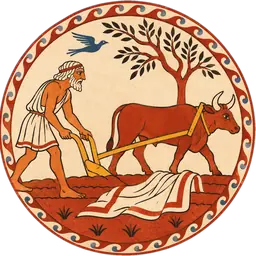
In Roman tradition, when a consul's army was trapped by the Aequi, the senate chose Lucius Quinctius Cincinnatus as dictator; Livy tells the story for those who think honour and virtue have no place where there is no wealth.1 The envoys found him working his own four-acre farm across the Tiber; he sent his wife Racilia for his toga, and they hailed him as dictator.2 He marched his army to Mount Algidus by night, trapped the Aequi, and sent them under a yoke of spears.3 He entered Rome in triumph and laid down the dictatorship on the sixteenth day, though it had been given him for six months.4 Cicero too tells that the news that he had been made dictator reached him at the plough.5
Events
What the sources say
“The one hope of Rome, L. Quinctius, used to cultivate a four-acre field on the other side of the Tiber, just opposite the place where the dockyard and arsenal are now situated; it bears the name of the “Quinctian Meadows”
spes unica imperii populi Romani L. Quinctius trans Tiberim, contra eum ipsum locum ubi nunc navalia sunt, quattuor iugerum colebat agrum, quae prata Quinctia vocantur
Livy 3.26.8 · tr. Rev. Canon Roberts
“Quinctius resigned on the sixteenth day the dictatorship which had been conferred upon him for six months”
Quinctius sexto decimo die dictatura in sex menses accepta se abdicavit
Livy 3.29.7 · tr. Rev. Canon Roberts
“and so, just as our ancestors brought the famous Cincinnatus from the plough to be dictator”
itaque ut maiores nostri ab aratro adduxerunt Cincinnatum illum, ut dictator esset
Cicero, On Ends 2.12 · AI translation (Claude)
First named
The earliest text in the library that names Cincinnatus, written about 45 BC (a modern estimate of when it was written):
“and so, just as our ancestors brought the famous Cincinnatus from the plough to be dictator”
itaque ut maiores nostri ab aratro adduxerunt Cincinnatum illum, ut dictator esset
Cicero, On Ends 2.12 · AI translation (Claude)
Found by searching every text in the library for these spellings and reading the earliest hits to rule out namesakes: Lucius Quinctius Cincinnatus, Cincinnatus, Quinctius, Κοίντιος, Κικιννᾶτος. Texts lost, or not in the library, may name Cincinnatus earlier.
The passages behind each sentence
- Livy 3.26 (tr. Rev. Canon Roberts) ↩
- Livy 3.26.8 (tr. Rev. Canon Roberts); Livy 3.26.10 (tr. Rev. Canon Roberts) ↩
- Livy 3.27 (tr. Rev. Canon Roberts); Livy 3.28.11 (tr. Rev. Canon Roberts) ↩
- Livy 3.29.4 (tr. Rev. Canon Roberts); Livy 3.29.7 (tr. Rev. Canon Roberts) ↩
- Cicero, On Old Age 56 (tr. William Armistead Falconer) ↩
Cite this page
MLA “Cincinnatus.” Atlas of Ancient History, Skirnir Studios, 2026, history.skirnirstudios.com/people/cincinnatus/.
APA Skirnir Studios. (2026). Cincinnatus. Atlas of Ancient History. https://history.skirnirstudios.com/people/cincinnatus/
Chicago “Cincinnatus.” Atlas of Ancient History. Skirnir Studios, 2026. https://history.skirnirstudios.com/people/cincinnatus/.
The atlas was written by AI from the ancient sources. Where you can, cite the ancient passage itself by its reference (Herodotus 7.228, Livy 22.7.3) and name the translation you read.