Atlas of Ancient History › People › The early Empire
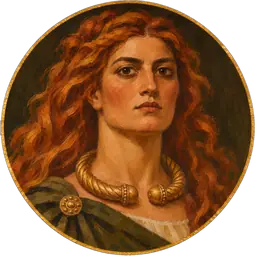
Boudicca
Boudicca was the wife of Prasutagus, king of the Iceni, who made the emperor co-heir with his two daughters; instead his kingdom was plundered, Boudicca was flogged and her daughters raped.1 In the consulship of Caesennius Paetus and Petronius Turpilianus (AD 61) the Iceni and the Trinobantes rose under her lead, stormed the Roman forts and burst into the colony at Camulodunum.2 Tacitus says the Britons drew no line of sex in command, and that she drove from tribe to tribe in a chariot with her daughters, saying she fought not as a queen but as one of the people, to avenge lost freedom, her scourged body and her daughters' honour.3 The governor Suetonius Paulinus routed her army; Tacitus reports that some put the British dead at almost 80,000 against about 400 Romans, and that Boudicca ended her life with poison.4
Events
What the sources say
“Boudicea, with her daughters before her in a chariot, went up to tribe after tribe, protesting that it was indeed usual for Britons to fight under the leadership of women. "But now," she said, "it is not as a woman descended from noble ancestry, but as one of the people that I am avenging lost freedom, my scourged body, the outraged chastity of my daughters. Roman lust has gone so far that not our very persons, nor even age or virginity, are left unpolluted. But heaven is on the side of a righteous vengeance; a legion which dared to fight has perished; the rest are hiding themselves in their camp, or are thinking anxiously of flight. They will not sustain even the din and the shout of so many thousands, much less our charge and our blows. If you weigh well the strength of the armies, and the causes of the war, you will see that in this battle you must conquer or die. This is a woman's re”
Boudicca curru filias prae se vehens, ut quamque nationem accesserat, solitum quidem Britannis feminarum ductu bellare testabatur, sed tunc non ut tantis maioribus ortam regnum et opes, verum ut unam e vulgo libertatem amissam, confectum verberibus corpus, contrectatam filiarum pudicitiam ulcisci. eo provectas Romanorum cupidines ut non corpora, ne senectam quidem aut virginitatem impollutam relinquant. adesse tamen deos iustae vindictae: cecidisse legionem quae proelium ausa sit; ceteros castris occultari aut fugam circumspicere. ne strepitum quidem et clamorem tot milium, nedum impetus et manus perlaturos: si copias armatorum, si causas belli secum expenderent, vincendum illa acie vel cadendum esse. id mulieri destinatum: viverent viri et servirent
Tacitus, Annals 14.35 · translator not recorded
“Rousing each other by this and like language, under the leadership of Boudicea, a woman of kingly descent (for they admit no distinction of sex in their royal successions), they all rose in arms”
His atque talibus in vicem instincti, Boudicca generis regii femina duce (neque enim sexum in imperiis discernunt) sumpsere universi bellum
Tacitus, Agricola 16.1 · translator not recorded
“Prasutagus, king of the Iceni, famed for his long prosperity, had made the emperor his heir along with his two daughters, under the impression that this token of submission would put his kingdom and his house out of the reach of wrong. But the reverse was the result, so much so that his kingdom was plundered by centurions, his house by slaves, as if they were the spoils of war. First, his wife Boudicea was scourged, and his daughters outraged. All the chief men of the Iceni, as if Rome had received the whole country as a gift, were stript of their ancestral possessions, and the king's relatives were made slaves”
Rex Icenorum Prasutagus, longa opulentia clarus, Caesarem heredem duasque filias scripserat, tali obsequio ratus regnumque et domum suam procul iniuria fore. quod contra vertit, adeo ut regnum per centuriones, domus per servos velut capta vastarentur. iam primum uxor eius Boudicca verberibus adfecta et filiae stupro violatae sunt: praecipui quique Icenorum, quasi cunctam regionem muneri accepissent, avitis bonis exuuntur, et propinqui regis inter mancipia habebantur
Tacitus, Annals 14.31 · translator not recorded
First named
The earliest text in the library that names Boudicca, written about AD 98 (a modern estimate of when it was written):
“Rousing each other by this and like language, under the leadership of Boudicea, a woman of kingly descent (for they admit no distinction of sex in their royal successions), they all rose in arms”
His atque talibus in vicem instincti, Boudicca generis regii femina duce (neque enim sexum in imperiis discernunt) sumpsere universi bellum
Tacitus, Agricola 16.1 · translator not recorded
Found by searching every text in the library for these spellings and reading the earliest hits to rule out namesakes: Boudicca, Boudiccae, Boudica, Boudicea, Boadicea, Βουδουίκα. Texts lost, or not in the library, may name Boudicca earlier.
The passages behind each sentence
- Tacitus, Annals 14.31 (translator not recorded) ↩
- Tacitus, Annals 14.29 (translator not recorded); Tacitus, Annals 14.31 (translator not recorded); Tacitus, Agricola 16.1 (translator not recorded) ↩
- Tacitus, Annals 14.35 (translator not recorded) ↩
- Tacitus, Annals 14.37 (translator not recorded); Tacitus, Agricola 16 (translator not recorded) ↩
Cite this page
MLA “Boudicca.” Atlas of Ancient History, Skirnir Studios, 2026, history.skirnirstudios.com/people/boudicca/.
APA Skirnir Studios. (2026). Boudicca. Atlas of Ancient History. https://history.skirnirstudios.com/people/boudicca/
Chicago “Boudicca.” Atlas of Ancient History. Skirnir Studios, 2026. https://history.skirnirstudios.com/people/boudicca/.
The atlas was written by AI from the ancient sources. Where you can, cite the ancient passage itself by its reference (Herodotus 7.228, Livy 22.7.3) and name the translation you read.