Atlas of Ancient History › People › The Hellenistic world
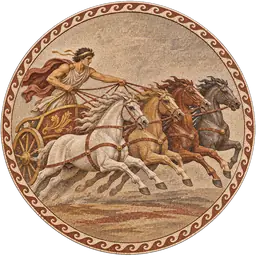
Agathocles
Agathocles' father, poor and settled at Syracuse, taught him the potter's trade as a boy, and Timaeus mocked him as a potter who came young to Syracuse from the wheel, the clay and the smoke.1 Diodorus dates his seizure of power at Syracuse to the archon Demogenes, and says the poor and indebted welcomed him because he promised to cancel debts and give out land.2 Besieged by the Carthaginians, he left a garrison in the city and crossed with picked troops to Africa, and when the successors of Alexander took the diadem he proclaimed himself king.3 He married his daughter Lanassa to Pyrrhus, with Corcyra, which he had captured, as her dowry.4 Polybius says he died in possession of his greatness, and that Scipio named Agathocles and Dionysius as the men who best joined daring to good sense.5
Events
What the sources say
“having been, as Timaeus sneeringly remarks, a potter—came from the wheel, clay, and smoke, quite a young man to Syracuse”
ὁ δʼ Ἀγαθοκλῆς, ὡς ὁ Τίμαιος ἐπισκώπτων φησί, κεραμεὺς ὑπάρχων καὶ καταλιπὼν τὸν τροχὸν καὶ τὸν πηλὸν καὶ τὸν καπνόν, ἧκε νέος ὢν εἰς τὰς Συρακούσας
Polybius 15.35.2 · tr. Evelyn S. Shuckburgh
“For Agathocles, learning that the rulers mentioned before had put on the diadem, and thinking himself inferior to them neither in forces nor in territory nor in achievements, proclaimed himself king.”
Ἀγαθοκλῆς γὰρ πυθόμενος τοὺς προειρημένους δυνάστας ἀνῃρημένους διάδημα καὶ νομίζων μήτε δυνάμεσι μήτε χώρᾳ μήτε τοῖς πραχθεῖσι λείπεσθαι τούτων ἑαυτὸν ἀνηγόρευσε βασιλέα
Diodorus 20.54.1 · AI translation (Claude)
“It is on this account that the story is told of Publius Scipio, the first conqueror of the Carthaginians, that being asked whom he considered to have been the most skilful administrators and most distinguished for boldness combined with prudence, he replied, the Sicilians Agathocles and Dionysius”
διὸ καὶ Πόπλιον Σκιπίωνά φασι τὸν πρῶτον καταπολεμήσαντα Καρχηδονίους ἐρωτηθέντα τίνας ὑπολαμβάνει πραγματικωτάτους ἄνδρας γεγονέναι καὶ σὺν νῷ τολμηροτάτους, εἰπεῖν τοὺς περὶ Ἀγαθοκλέα καὶ Διονύσιον τοὺς Σικελιώτας
Polybius 15.35.6 · tr. Evelyn S. Shuckburgh
“Don’t I know you, Menaechmus, the son of your father Moschus, who are said to have been born in Sicily, at Syracuse, where King Agathocles reigned, and after him Pintia, the third Liparo, who at his death left the kingdom to Hiero—which Hiero is now king”
Non ego te novi Menaechmum, Moscho prognatum patre, qui Syracusis perhibere natus esse in Sicilia, ubi rex Agathocles regnator fuit et iterum Phintia, tertium Liparo, qui in morte regnum Hieroni tradidit, nunc Hiero est
Plautus, Menaechmi 2.3 · tr. Henry Thomas Riley
First named
The earliest text in the library that names Agathocles, written about 195 BC (a modern estimate of when it was written):
“Don’t I know you, Menaechmus, the son of your father Moschus, who are said to have been born in Sicily, at Syracuse, where King Agathocles reigned, and after him Pintia, the third Liparo, who at his death left the kingdom to Hiero—which Hiero is now king”
Non ego te novi Menaechmum, Moscho prognatum patre, qui Syracusis perhibere natus esse in Sicilia, ubi rex Agathocles regnator fuit et iterum Phintia, tertium Liparo, qui in morte regnum Hieroni tradidit, nunc Hiero est
Plautus, Menaechmi 2.3 · tr. Henry Thomas Riley
Found by searching every text in the library for these spellings and reading the earliest hits to rule out namesakes: Ἀγαθοκλῆς, Agathocles. Texts lost, or not in the library, may name Agathocles earlier.
The passages behind each sentence
- Diodorus 19.2.7 (AI translation (Claude)); Polybius 15.35.2 (tr. Evelyn S. Shuckburgh) ↩
- Diodorus 19.2.1 (AI translation (Claude)); Diodorus 19.9.5 (AI translation (Claude)) ↩
- Diodorus 20.3.3 (AI translation (Claude)); Diodorus 20.54.1 (AI translation (Claude)) ↩
- Plutarch, Pyrrhus 9.1 (tr. Bernadotte Perrin) ↩
- Polybius 15.35.5 (tr. Evelyn S. Shuckburgh); Polybius 15.35.6 (tr. Evelyn S. Shuckburgh) ↩
Cite this page
MLA “Agathocles.” Atlas of Ancient History, Skirnir Studios, 2026, history.skirnirstudios.com/people/agathocles/.
APA Skirnir Studios. (2026). Agathocles. Atlas of Ancient History. https://history.skirnirstudios.com/people/agathocles/
Chicago “Agathocles.” Atlas of Ancient History. Skirnir Studios, 2026. https://history.skirnirstudios.com/people/agathocles/.
The atlas was written by AI from the ancient sources. Where you can, cite the ancient passage itself by its reference (Herodotus 7.228, Livy 22.7.3) and name the translation you read.